If you’ve ever bitten into a biscotti and thought, “This is hard!” — you’re absolutely right.
It’s supposed to be.
Biscotti are not delicate cookies meant to crumble in your hand. They are sturdy, rustic, and intentionally crisp. And once you understand their history, that crunch makes perfect sense.
Let’s take a little journey back to where it all began.
A Cookie Born from Practicality
The word biscotti comes from the Latin bis coctus, meaning “twice cooked.”
The technique dates all the way back to the Roman Empire. Roman soldiers needed food that could travel long distances without spoiling. Bread was baked twice to remove moisture, making it dry, durable, and long-lasting.
That same idea evolved centuries later into what we now recognize as biscotti — especially in Tuscany.
In the Tuscan town of Prato, a version called cantucci became famous. Traditionally made with whole almonds and very little moisture, these cookies were designed to last — and to be dipped.
Why Biscotti Are Baked Twice
Here’s how it works:
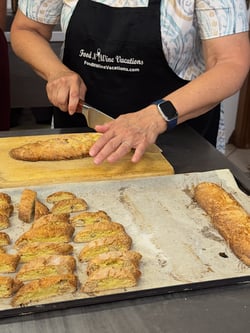
- The dough is shaped into long logs and baked once.
- While still warm, the logs are sliced into individual pieces.
- The slices go back into the oven for a second bake.
That second bake is what gives biscotti their signature firmness and long shelf life.
Biscotti are intentionally dry. That dryness isn’t a flaw — it’s a feature. It concentrates flavor and creates the perfect texture for dipping.
Hard by Design — Perfect for Vin Santo
In Tuscany, biscotti are traditionally served with Vin Santo — a golden, slightly sweet dessert wine.
The ritual is simple:
- Sit at the table.
- Pour a small glass of Vin Santo.
- Dip the biscotti.
- Talk. Laugh. Stay awhile.
The wine softens the cookie just enough. The almonds release their flavor. The moment slows down.
Biscotti were never meant to be rushed or eaten on the go. They belong at the end of a meal, when plates are cleared and conversation begins to deepen.
A Cookie Made for Community
In many Tuscan homes, biscotti are baked in batches and stored in tins. They’re pulled out when guests arrive, when neighbors stop by, or when a long meal stretches into the evening.
They represent something very Italian:
Food is not just nourishment. It’s a reason to gather.
They are hard because they were designed to endure.
They are baked twice because that’s how they’ve always been.
And they are best enjoyed not alone, but at a table, with friends, with a glass of something sweet.